

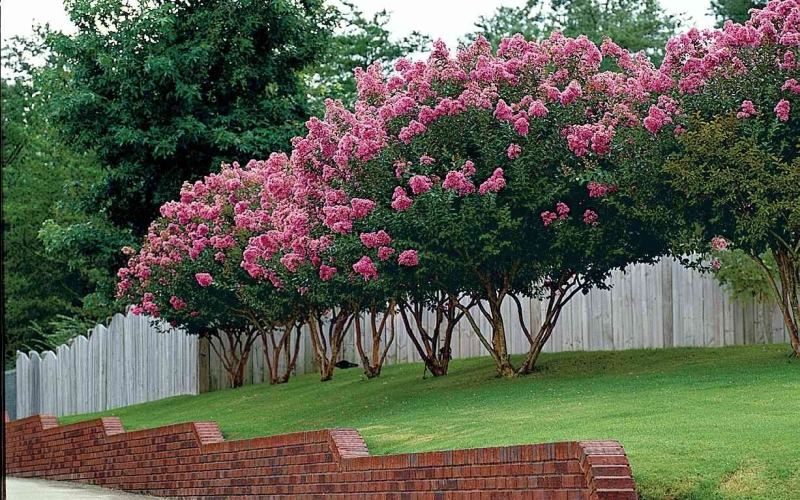
If you are passionate about gardening, at some point you will consider planting trees. Certainly, you have to know that some trees and shrubs are better than others, so there are several important aspects that you should take into account before planting trees in your garden.
The use and choice of trees in gardens will depend on factors such as the size of the garden, the terrain, the climate, and the adult size of each plant. If you lack experience in this regard, consulting tree and shrub experts is always the best option.
Curb appeal is certainly very important for every home, but in addition to considering a tree’s ability to provide shade and coolness during the hot summer months, there are other essential aspects to consider.
Some trees have very deep and strong roots that can slowly damage the foundation of your home. Others have weak wood or are known to attract various diseases and pests. greenhouse Others can grow invasively or even be very poisonous, putting your children or pets at risk.
Poplar
Many people prefer poplar (genus Populus) over other trees, given their aesthetically pleasing appearance and low maintenance. However, the poplar has a very shallow and soft root system. Its wood is prone to rot, making it very unstable during severe storms.
In addition to the fact that the tree itself is quite fragile, it can also be damaged by insects and diseases, making it even more exposed to the elements.
Given the superficiality of its roots and the propensity to form new trees from them, we may encounter the problem of having planted a poplar in an area of the garden, and new poplars begin to grow in areas that we did not expect.
Jacaranda
The Jacaranda (Jacaranda mimosifolia) is a subtropical tree native to South America and widely cultivated for its showy and long-lasting violet flowers. Due to their decorative appearance, jacarandas are highly appreciated in gardening. Its roots are not invasive, so when there is a period of water scarcity the tree looks very bad. Growing jacaranda trees is mainly a matter of having the right environment,
Jacarandas are true southern trees, thriving in coastal areas. This tree does not develop well in cold areas. Flowering occurs in spring, and there may be a second flowering in early fall; When the flowers fall, they cover the ground in a thick layer and must be raked before they decompose. Also, during this period, do not park your car nearby if you do not want it to get dirty.
Pine tree
Although white pine (Pinus halepensis) does not reach staggering heights like other trees, it is not a great choice for cold climates. On the other hand, its extremely sticky resin can damage your car or if you have artificial grass, making it very difficult to clean. Additionally, the pine is also known to attract the pine processionary (Thaumetopoea pityocampa) which is a dangerous pest, so you have to ask yourself if this tree is really worth it.
Mulberry
Most people should avoid planting this tree in their garden simply because it produces large amounts of pollen which, in addition to attracting insects, can be unpleasant for allergies. Mulberry trees (Morus alba) are extremely invasive, if you cut a mulberry tree it will grow again and again, they also produce mulberries that will stain anything they touch. Although it can offer great summer shade, it is still not worth the inconvenience it may cause. If you still want a mulberry tree, tell you that there are also other varieties on the market that are “fruitless”.
Mimosa
Like poplar, mimosa (Acacia dealbata and Albizia julibrissin) has particularly weak wood that makes it a highly unpredictable tree during storms. This type of tree also attracts aphids and other pests, plus mimosa is also famous for producing seeds that germinate quickly so you could end up with a huge mimosa forest faster than you think.
In addition to belonging to an intrusive genus, the mimosa is a difficult specimen for gardeners to maintain. Bright pink flowers adorn the tree in summer, transforming into squashed bean-like pods in the fall. Very beautiful visually, but it translates into a lot of maintenance and cleaning in the garden, it is also a species that tolerates aggressive pruning very poorly, since it does not heal wounds well.
